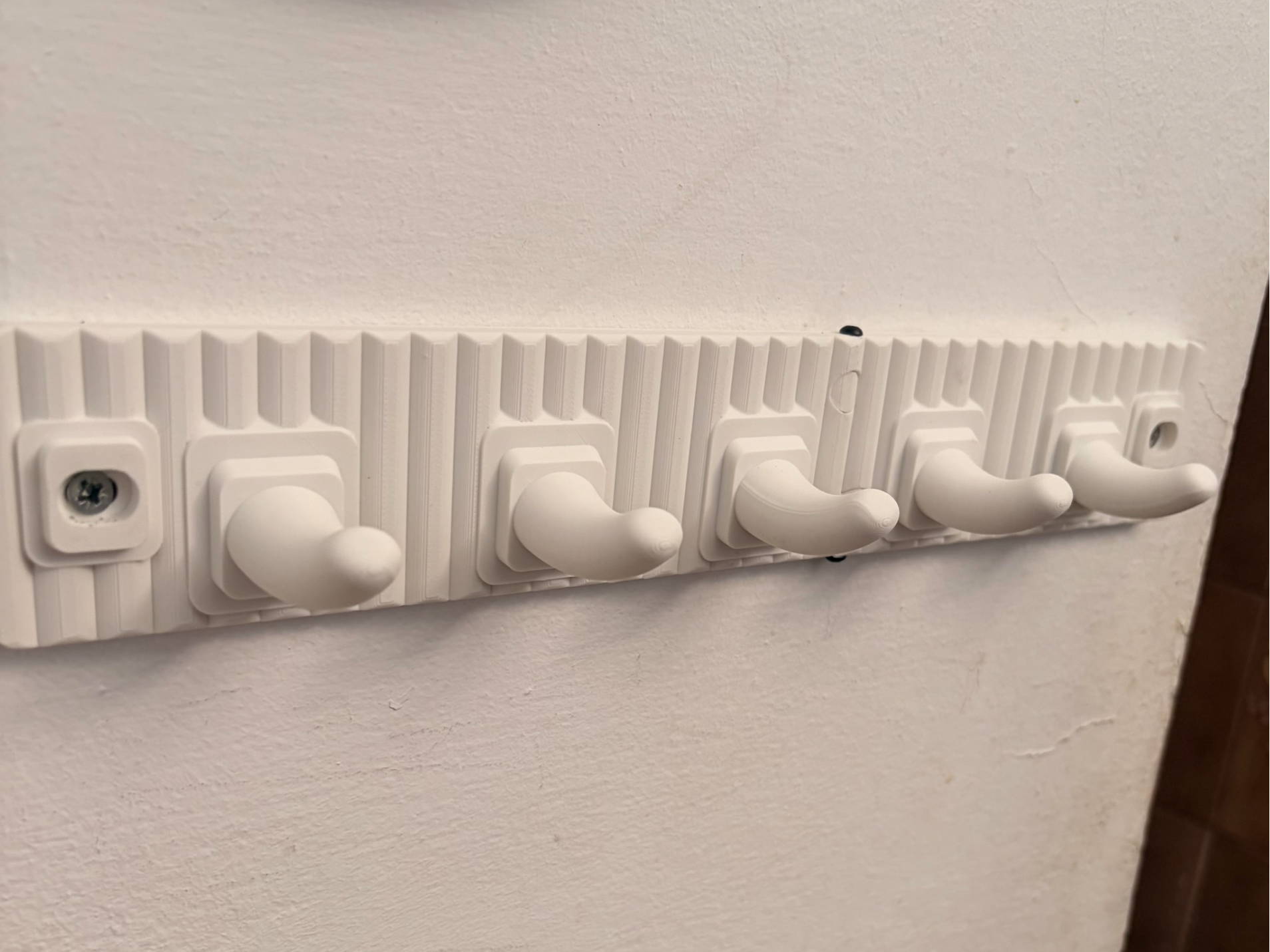
A wall-mounted towel rail with five scooped hooks, wrapped in art-deco reeding. Simple to print and simple to hang, but it doesn't look like a printed part — the vertical fluting catches bathroom light the way ribbed glass does, and the hooks are smooth ovals with no sharp edges to catch or poke you. Prints in two halves with no supports, joins with a hidden puzzle seam, and takes two screws on the wall. Before you start: the screw spacing is fixed The two wall screws sit exactly 300 mm apart. The holes are slotted ±2 mm to absorb small errors, but that's the whole adjustment range. If you're drilling fresh holes, just mark them 300 mm apart and you're fine. What you need • 2 wall screws — up to Ø5 mm shank, head up to Ø9.5 mm • 2 wall anchors to suit your wall — these carry the load, not the plastic • 2 M2 × 12–16 self-tapping screws to join the halves No glue, no inserts, no supports. Dimensions Overall: 340 × 55 mm, standing 51 mm off the wall Base plate: 6 mm thick, reeds bulging to 8.5 mm Reeding: 34 half-round flutes, 10 mm pitch Screw spacing: 300 mm, centred Screw holes: Ø5 mm, slotted ±2 mm Counterbore: Ø9.5 × 4.5 mm deep, so heads sit 2 mm below the surface Hooks: 5, on a 59 mm pitch Hook reach: 51 mm from the wall, about 42 mm clear of the fluted face The hook is a smooth scoop — it dives 5.4 mm, then lifts back up to finish above where it started. A towel settles into the low point instead of sliding around, and it's held by the curve rather than just resting in a trough. Printing • 128.7 g and about 4 h 10 m for both halves on one plate (A1, 0.4 nozzle, PLA, 0.20 mm layers, 4 walls, 25 % gyroid) • No supports. Every overhang is held under 45° — the hook tips stop at 43° for exactly this reason • No brim needed. Both halves lie flat on their backs with plenty of bed contact • Bed: 210 × 60 mm minimum. The larger half is 209 mm long, so any 220 × 220 bed is fine; a 180 mm bed is not Both STLs are already oriented flat-back-down with the hooks pointing up, so they drop onto the plate as-is. Don't rotate them — the hook roots are designed around that layer direction. White PLA is what this was designed around and it's plenty strong. PETG is tougher against a sudden yank, but it strings more, and stringing is exactly what ruins fluting. Assembly 1. Slide the two halves together face-on, the way they'll sit against the wall. The puzzle tabs lock them lengthwise and vertically. 2. Drive the two M2 screws — one into the bottom edge, one into the top edge, near the seam. Pilot holes are already there and the heads recess below the edge. 3. Screw it to the wall. Once mounted, the wall blocks the only direction the joint could ever come apart in, so the M2 screws are really just there to hold it together while you handle it. Why two parts? A 340 mm strip doesn't fit on a 256 mm bed, even diagonally. The seam sits off-centre in a flute valley, where the vertical reeding hides it. How much will it hold? Comfortably more than five wet bath towels. A single hook loaded with 15 kg right at the tip still leaves about a 3.4× safety factor, and a realistic wet towel leaves roughly 25×. With all five loaded, each wall screw sees around 5.5 kg of pull-out force — your wall anchors are the limiting factor here, not the printed part, so put decent ones in.
Fluted Towel Hanger/Rack — 5 Hooks
by David Rein · original on MakerWorld ↗
♥ 1⬇ 0🖨 1 prints
Print profiles
0.2mm layer, 4 walls, 25% infill
⏱ 4h 22m · 135 g · 1 material(s)
Prints on: A1 0.4, X1E 0.4, P2S 0.4, H2C 0.4, H2D 0.4, A2L 0.4, X1 Carbon 0.4, X2D 0.4, H2D Pro 0.4, P1P 0.4, H2S 0.4, X1 0.4, P1S 0.4PLA
Not printable on our printers