Section 3: Catalogue of Significant Artifacts from Sector Ulysses, Site 23
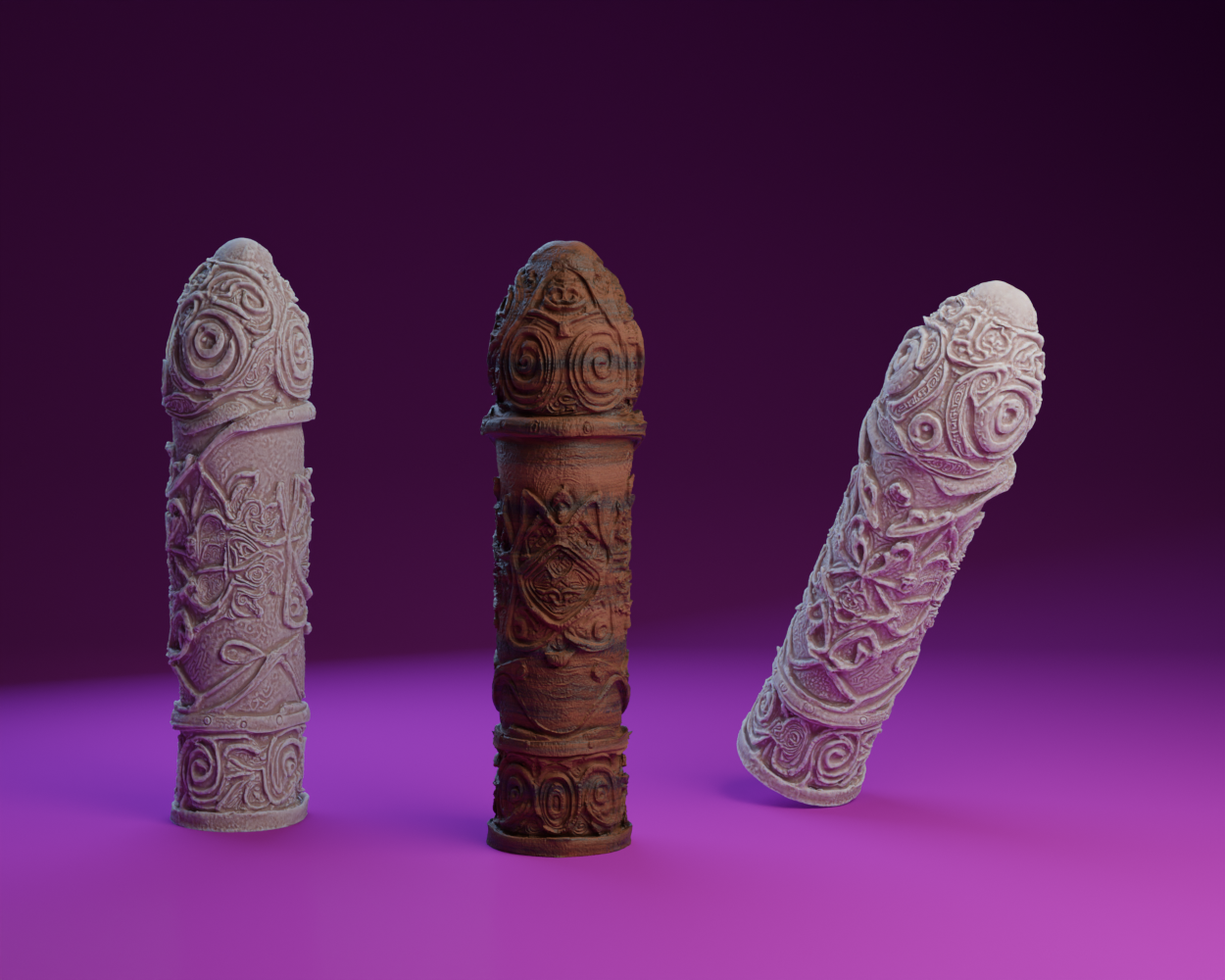
3.7 Artifact VN-07-SU-23: Elaborately Carved Phallic Effigy
Recovery Context: Artifact VN-07-SU-23 was recovered from Stratum III-b within Sector Ulysses, Site 23. This stratum has been radiocarbon dated to the late 9th to mid-10th century CE, correlating with the established peak of Norse activity in the southern littoral region of the excavation area. The artifact was situated in close proximity to the remnants of what is tentatively identified as a domestic longhouse structure (Feature 12), though its precise function within this context remains under investigation. Associated finds within the immediate vicinity include fragmented ceramic vessels of probable Scandinavian origin, iron implements exhibiting signs of ritualistic bending or breakage (cf. Price, 2002), and a scatter of animal bone, predominantly cervid and porcine.
Detailed Morphological and Decorative Analysis: The artifact presents as a solid, elongated form (length: 24.8 cm, proximal diameter: 5.3 cm, distal diameter: 4.1 cm) exhibiting a distinct glans-like terminus and a subtly contoured shaft. Macroscopic analysis of the material suggests a high degree of petrification, likely of a hardwood species indigenous to the region during the period of deposition. The surface is remarkably well-preserved, exhibiting an intricate network of deeply carved decorative elements.
The primary decorative motif is a centrally positioned Vegvísir, a symbol frequently interpreted as a navigational aid or a charm intended to prevent the bearer from losing their way in storms or bad weather (Ellis Davidson, 1988). Here, the eight staves emanating from the central point are rendered with precision and are integrated into the surrounding interlace patterns. These interlacing bands, characteristic of the Mammen style (Wilson & Klindt-Jensen, 1966), are executed with fluid lines and incorporate stylized animal heads at key junctures, a hallmark of this artistic phase.
Further examination reveals the presence of what appear to be runic inscriptions integrated within the decorative framework. While heavily stylized and potentially abbreviated, preliminary epigraphic analysis suggests possible linkages to bindrunes or galdrastafir, magical staves often associated with protection and potent energies (Flowers, 1992). The consistent application of a dark, organic pigment within the carved recesses underscores the deliberate aesthetic intention and potentially imbued the artifact with additional symbolic weight.
Discussion and Preliminary Interpretation: The discovery of a phallic effigy of this scale and artistic complexity within a domestic context presents a compelling, albeit potentially sensitive, avenue of inquiry into the belief systems and ritual practices of the Norse inhabitants of Site 23. While phallic representations are not uncommon in the archaeological record, particularly in fertility cults and as symbols of masculine power, the intricate detailing and the incorporation of the Vegvísir and potential magical runes suggest a function beyond simple representation.
Several interpretations warrant consideration:
- Apotropaic Function: The presence of the Vegvísir and possible protective runes strongly suggests a talismanic purpose, intended to ward off misfortune or provide guidance and safety to the household or an individual. The phallic form itself might have been associated with vitality, strength, and the protection of the domestic sphere.
- Ritualistic Object: The artifact may have played a role in specific household rituals or ceremonies, possibly related to fertility, prosperity, or the honoring of specific deities. The deliberate artistic execution implies a significant cultural value attached to the object.
- Symbolic Representation: The effigy could represent a more abstract concept related to Norse cosmology or mythology. Further research into the symbolic associations of phallic forms and the specific deities venerated during the relevant period may shed light on this possibility.
Future Research Directions: Ongoing research will focus on:
- Advanced Material Analysis: Spectroscopic analysis to definitively identify the type of wood and the composition of the pigment.
- Detailed Epigraphic Analysis: Collaboration with runologists to decipher the stylized inscriptions and assess their potential meaning.
- Comparative Studies: Examination of similar artifacts from other Norse sites to identify parallels in form, decoration, and context.
- Contextual Analysis: Further investigation of the surrounding archaeological features to better understand the artifact's depositional context and its relationship to other finds.
The elaborate nature of Artifact VN-07-SU-23 underscores the rich symbolic landscape of the Norse presence at Site 23 and highlights the potential for even seemingly straightforward forms to carry complex cultural and religious significance. Further investigation promises to yield valuable insights into the daily lives, beliefs, and artistic expressions of this community.
References:
- Ellis Davidson, H. R. (1988). Myths and Symbols in Pagan Europe. Syracuse University Press.
- Flowers, S. E. (1992). Runes and Magic: Magical Formulae and Ancient Scandinavian Rune Wisdom. Inner Traditions.
- Price, N. (2002). The Archaeology of Sacrifice. Routledge.
- Wilson, D. M., & Klindt-Jensen, O. (1966). Viking Art. Cornell University Press
Elaborately Carved Phallic Effigy : Norse
by Zaphrod Beeblebrox · original on Printables ↗
Art & Design / Sculptures
♥ 42⬇ 1.5k🖨 0 prints
Print profiles
norsedil.3mfDEFAULT
⏱ time and weight estimated after preparation · 1 material(s)
Made to order: we prepare this file when you order, which adds a few minutes before printing starts.
Prints on: A1 mini 0.4PLA
Order this print
norsedil.obj
⏱ time and weight estimated after preparation · 1 material(s)
Made to order: we prepare this file when you order, which adds a few minutes before printing starts.
Prints on: A1 mini 0.4PLA
Order this print