Update 07/06/2026
FreeCAD redesign is done! Testing is on its way. There will be many new parameters for more control; the model will be more resilient to changes; more sizes will be available; A new derivative design will exist (one that let's the water exit); and in the future, there will be more closing mecanisms! Stay tuned.
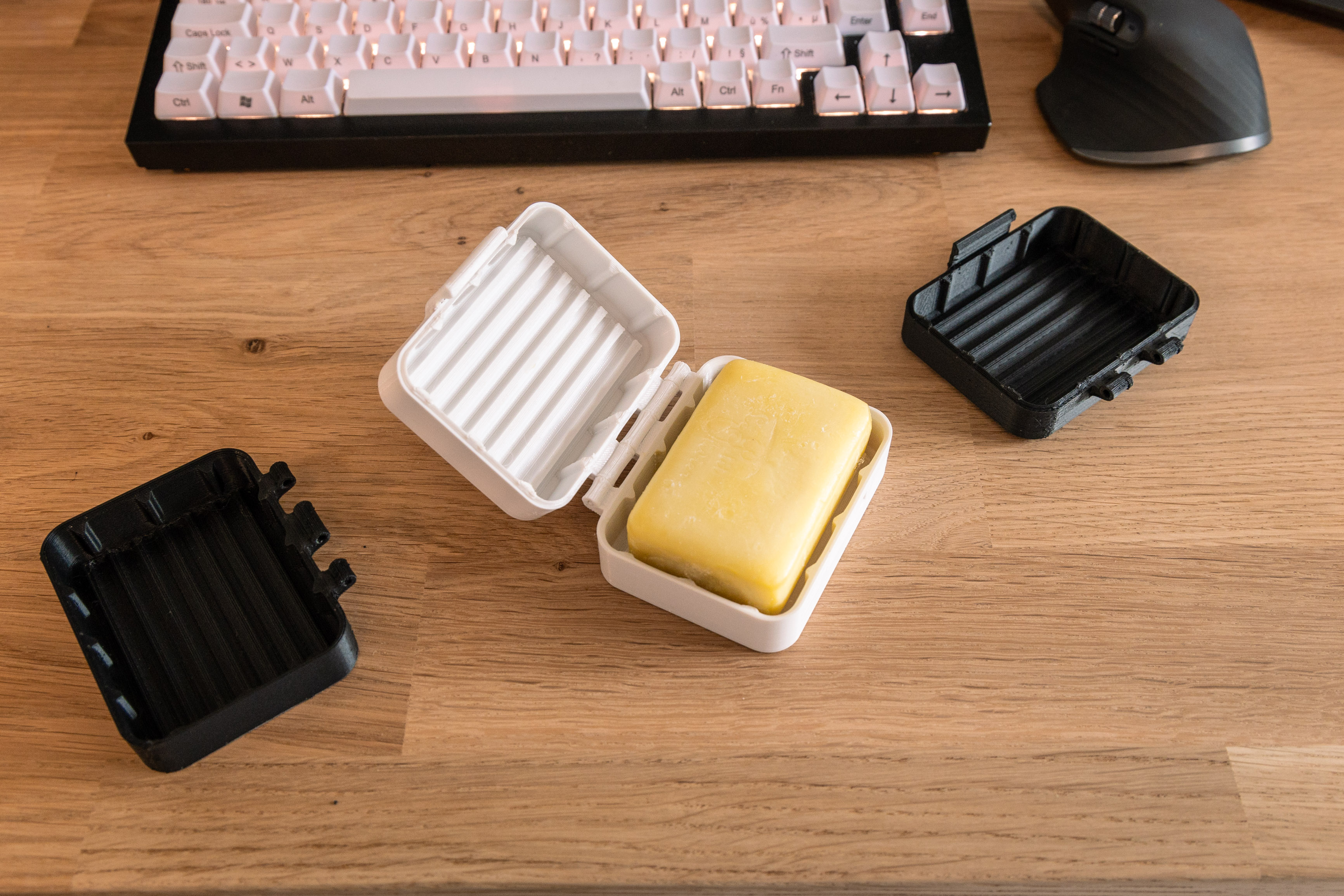
In my quest for the perfect soap box for travel, I haven't found what I wanted. So here is a fully parametric travel hinged soap box.
The hinge articulates around a portion of filament (you can finally use these old filaments of 10cm).
The whole box can be printed in one time without support. It took 3H30 on my printer using relatively low speed and a layer height of 0.28mm. If you are using Cura, you can try the fuzzy skin parameter with “outside only” to have a textured finish.
Table Of Content
Model parameters
Design decisions
Bumps
Hinge
Joint
Closing mechanism
Model parameters
Name | Value | Unit | Comment |
soap_length | 75 | mm | The length of your soap (how long is it?) |
soap_width | 55 | mm | The width of your soap (how large is it?) |
soap_thickness | 25 | mm | The height of your soap (how tall is it?) |
soap_margin | 1 | mm | Give some slack in your measurements |
box_wall_thickness | 2.4 | mm | how thick will the box walls be |
box_bottom_thickness | 1.3 | mm | how thick will the bottom and top surfaces be (can be smaller because of the bottom and top bumps. |
box_radius | 8 | mm | define the corner rounding radius |
ergo_height | 2.5 | mm | the height of the bottom and top bumps |
side_ergo_size | 2 | mm | the width of the side bumps |
hinge_hole_diameter | 2.5 | mm | how large should the hole be |
The fusion360 model is parametric: you can create the soap box that suits your needs. The only one that needs comment is the “hinge_hole_diameter”. I found that for 1.75mm PLA, a 2.5mm would be great on my printer (CR6-SE). The hinge can print without support, but the layer height can impact the true size of the hole.
The number of bumps and their position will automatically adjust regarding your soap size, the margin and the side bumps width. However, the hinge will not adjust its length automatically if the box becomes too small.
Design decisions
Bumps
The soap can be stored wet in a box, and reject some water. To avoid it from melting down, some spacers were added. In order to minimize the contact surface, there are 2 types of spacers:
- The bottom and top ones ensure the soap will not be in its own water. They were revised in this V2, and offer much greater surface contact as it has been observed that softer soaps were damaged by the V1 small bumps.
- The side ones are just there to avoid wet soap sticking to the walls, and to provide more stiffness to the design.
Hinge
The hinge was subject to a few changes. After having printed a print-in-place soap box, I found that tolerances were a pain to deal with. The very first design made use of magnets, but as they are relatively expensive, not really climate-friendly, and not everyone has some home. I decided to go with a plastic hinge instead. The two parts of the box are totally separated from each other.
To make the hinge, just insert a few centimeters of your filament through the holes and voilà! Cut the filament to size, and you can glue the two ends to make sure the filament will never come out.
Joint
The closing joint does not have any right angles and features a 45° slope instead. This prevents water and dirt from accumulating in hard-to-get places.
Closing mechanism
The box is kept closed with a constrained mechanism. It was by far the simplest mechanism and one of the most reliable. The box is firmly closed.
If you want to adjust how much force is required to open the box, you can open the source file and edit the last sketch in history (called lock_mechanism). Here, you can play on
The distance from the flexion point to the joint (the separation between the top and bottom part). Reducing this distance will increase the force required to open the box as the closing bit will not be able to flex as much.
The depth of the closing hole. By default, the depth of the closing hole in half of the box thickness. A deeper hole will increase the force required to open the box as the closing bit will need to flex more to go out the hole.
The width of the closing mechanism. For this, you will need to adjust the two extrusions that are after the lock_mechanism sketch.
Version history
V2.12 | Original printable design |
V2.13 |
|
V2.14 |
|
Parametric travel soap box
by Marc Bresson · original on Printables ↗
Household / Bathroom
♥ 250⬇ 1.8k🖨 18 prints
Print profiles
Engineered soap box - S.stlDEFAULT
⏱ time and weight estimated after preparation · 1 material(s)
Made to order: we prepare this file when you order, which adds a few minutes before printing starts.
Prints on: A1 mini 0.4PLA
Order this print
Engineered soap box - L.stl
⏱ time and weight estimated after preparation · 1 material(s)
Made to order: we prepare this file when you order, which adds a few minutes before printing starts.
Prints on: A1 mini 0.4PLA
Order this print