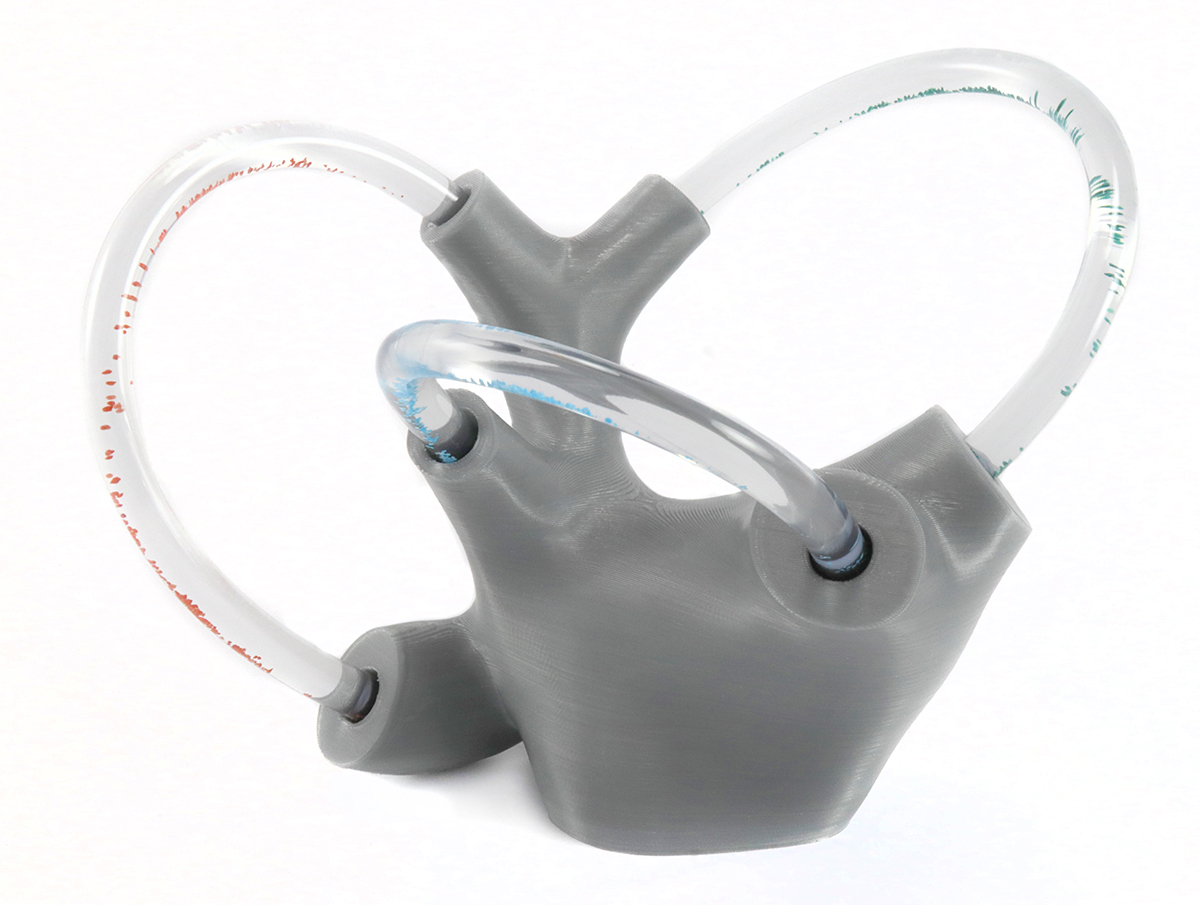
Learn how positional vertigo works by watching the crystals (aka "otoconia" or "otolith") fall and move through the semicircular canals of your inner ear anatomy with this educational model. We developed this anatomical model to promote the understanding of fluid dynamics as well as how our inner ear crystals respond to gravity when displaced in the canals. This model can demonstrate how BPPV repositioning techniques such as the Epley work. Perfect for use with patients, students, and clinical mentorship and training.
If you're not a DIYer and want to support our mission of developing the most affordable and innovative vestibular technologies, you can purchase a pre-built fluid-filled vestibular apparatus on our website.
Print and Material Instructions
Visit our website for a detailed tutorial to build a fluid-filled vestibular apparatus We designed this model to use off-the-shelf components that can be sourced online and locally, although your mileage may vary designed on your region.
Fluid-Filled Vestibular Apparatus for Vertigo Education
by Vestibular First · original on Printables ↗
Learning / Chemistry & Biology
♥ 93⬇ 1.9k🖨 2 prints
Print profiles
Apparatus - Fluid - Large v10b - Right (Print Ready).stlDEFAULT
⏱ time and weight estimated after preparation · 1 material(s)
Made to order: we prepare this file when you order, which adds a few minutes before printing starts.
Prints on: A1 mini 0.4PLA
Order this print
Apparatus - Fluid - Large v10b - Left (Print Ready).stl
⏱ time and weight estimated after preparation · 1 material(s)
Made to order: we prepare this file when you order, which adds a few minutes before printing starts.
Prints on: A1 mini 0.4PLA
Order this print